As developers at MarkData Consulting, we do not look for AI that writes code for us. We look for AI that thinks with us, inside real and complex systems. That is where JetBrains Junie, working with our guidelines, and agentic AI coding stand out.
What is Junie?
Junie is the AI coding agent from JetBrains that works inside IntelliJ IDEA and other JetBrains IDEs. Unlike autocomplete, which suggests the next line, an agentic coding assistant takes a whole task: it explores the project, plans the change, edits several files, runs the build and tests, and reports what it did for a developer to review. Teams can give it written project guidelines, such as coding conventions, architecture rules and domain rules, that it follows on every task.
Why agentic coding feels different from autocomplete
Junie behaves like an engineering partner that:
- understands project-level intent, not just isolated files;
- follows internal guidelines, domain rules and architectural patterns;
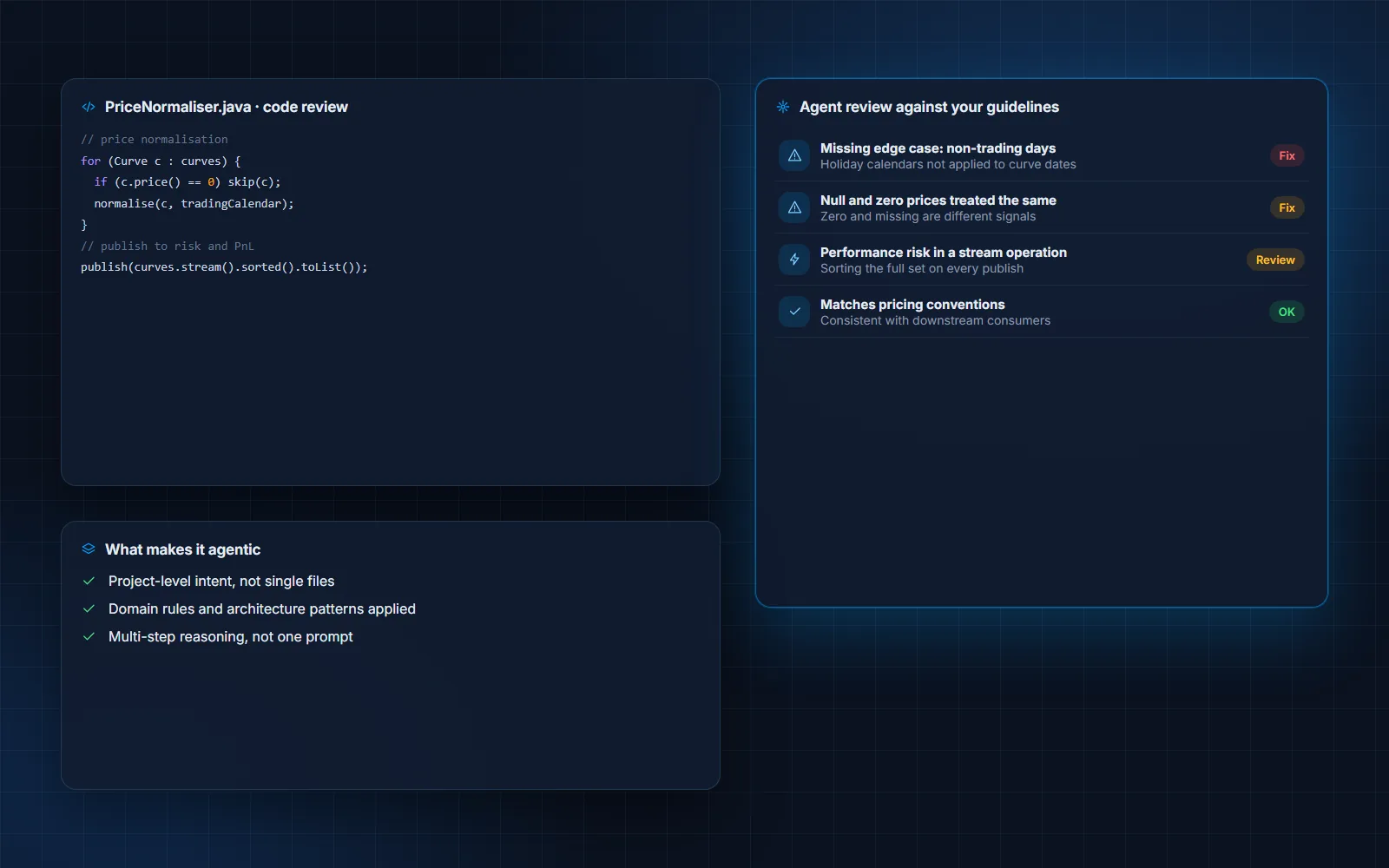
- reasons across multiple steps, not single prompts.
Instead of asking it to generate a method, we ask whether an implementation is safe, consistent and correct for the domain, and it answers with context.
A real use case: a market data validation pipeline
In one of our market data ingestion pipelines we process millions of price curves and reference data points every day. A small validation gap can cascade into incorrect PnL, bad risk metrics and downstream reconciliation issues. The logic spans several services, shared validation rules and edge cases that only senior engineers know.
We configured Junie with our data validation guidelines and domain rules. While we refactored a price normalisation module, it:
- flagged a missing edge case for non-trading days;
- highlighted inconsistent handling of null and zero prices;
- detected a performance regression risk in a stream operation.
AI code review against our own conventions
During code review it also checked that the changes matched our existing pricing conventions, what downstream consumers expect, and our internal error-handling standards. Problems that used to surface in the second or third review round were raised before a person looked at the change.
What changed
- Less back-and-forth during reviews
- Fewer production hotfixes
- Junior developers shipping changes with senior-level confidence
This was not AI writing code. It was AI applying engineering judgement.
How to get value from an agentic coding assistant
- Write the guidelines down. The agent can only follow rules it can read: naming, error handling, domain conventions and the edge cases senior engineers carry in their heads.
- Give it tasks with a clear finish line: a refactor with tests that must pass, a review against a checklist, a bug with a failing test.
- Keep people on the merge button. Every change is reviewed like a colleague’s pull request.
- Let it review as well as write. Asking the agent to check a change against your conventions catches problems before human review.
- Protect secrets and data. Keep credentials and production data out of prompts and out of the code the agent can see.
Why this matters for CTRM and market data systems
In our world, context beats syntax, consistency beats speed, and safety beats cleverness. Agentic AI in the IDE keeps domain knowledge from being lost, enforces best practice automatically and keeps complex systems maintainable as teams grow. It is the difference between code that compiles and code that is correct for the business.
Frequently asked questions
What is an agentic AI coding assistant?
It is an AI tool that completes development tasks rather than suggesting single lines: it reads the codebase, plans a change across files, runs builds and tests, and explains the result for a developer to review.
How is agentic coding different from code completion?
Code completion predicts the next few lines as you type. An agentic assistant works on a whole task: it can change several files, run tests and iterate until they pass, so it needs clear instructions and the same review as any other contributor.
Can AI do code review?
Yes, as a first pass. Given your guidelines, an AI agent can check a change for missed edge cases, inconsistent conventions and risky patterns before a person reviews it. It reduces review rounds; it does not replace the reviewer.
Is it safe to use AI coding agents on enterprise code?
It can be, with the right setup: approved tools, no secrets or production data in prompts, review of every change, and tests that must pass before anything is merged.
We see agentic AI as a way to scale engineering judgement, not just output. Read more about our AI agent engineering and market data engineering work, or talk to us about applying it to your platform.
Related reading: what is agentic AI?; AI agents in software testing.