Agentic AI is artificial intelligence that pursues a goal on its own. Instead of answering one question and stopping, an AI agent plans the steps needed to reach a goal, uses tools and business systems to carry them out, checks the results and adjusts its plan, while people set the limits and approve what matters.
A chatbot can tell you how to reconcile an invoice. An agent can open the invoice, find the purchase order and the delivery note, compare them, flag the difference, draft the email to the supplier and wait for a person to approve it. That shift, from answering to doing, is why agentic AI has become one of the most searched topics in technology.
How agentic AI works
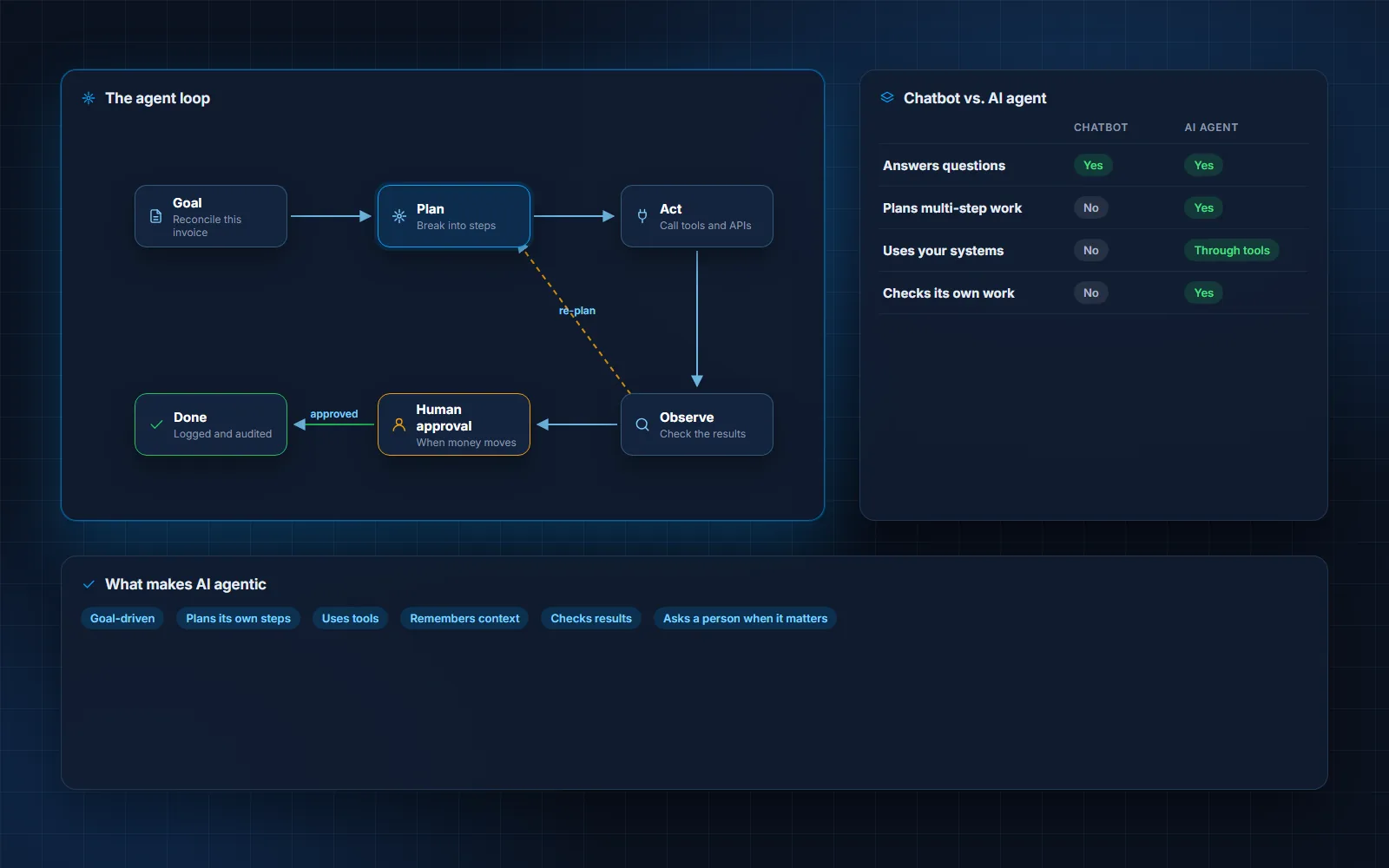
Almost every AI agent runs the same loop:
- Goal. A person or another system gives the agent an objective, such as “prepare the weekly exposure report”.
- Plan. A large language model breaks the goal into steps and decides which tool to use for each one.
- Act. The agent calls tools: a database query, an API, a document search, a spreadsheet or another agent.
- Observe. It reads the results and checks them against the goal and its rules.
- Adjust or finish. If something is missing or wrong, it re-plans. If an action is risky, it asks a person first. When the goal is met, it reports back and logs what it did.
Around that loop sit five building blocks: the model that reasons, the tools it is allowed to use, memory of the task and past decisions, guardrails that limit what it can do, and orchestration that runs the steps reliably and records them. Open standards such as the Model Context Protocol (MCP) make it easier to give agents safe, well-defined access to business systems.
Agentic AI vs. generative AI, chatbots and RPA
- Generative AI creates content (text, code, images) in response to a prompt. Agentic AI uses generative models as its reasoning engine, but adds planning, tools and action.
- Chatbots hold a conversation. Agents complete tasks, often with no conversation at all.
- Robotic process automation (RPA) follows fixed scripts and breaks when a screen or format changes. Agents handle variation, such as a supplier email written in a new way, because they understand the content.
- Traditional automation is still the right answer for steps that never change. Good agent designs use automation for the predictable parts and the agent only where judgement is needed.
Examples of AI agents in business
- Finance operations: matching invoices, purchase orders and receipts, and preparing exceptions for review.
- Commodity trading: comparing counterparty confirmations with booked trades and flagging mismatches. See our Trade Confirmation Agent.
- Shipping and logistics: reading quote requests and proposing spot rates within pricing rules, as our Freight Quote Agent does.
- IT and support operations: triaging alerts and tickets, gathering diagnostics and suggesting a fix for the on-call engineer.
- Software engineering: reviewing code against team guidelines and running end-to-end tests overnight.
- Customer service: resolving routine requests end to end and handing complex ones to a person with the context already gathered.
Single agents and multi-agent systems
Simple tasks need one agent with a few tools. Larger processes often work better as a multi-agent system: a planner agent hands work to specialist agents (one reads documents, another queries systems, another checks compliance), and a supervisor combines the results. Frameworks such as LangGraph help orchestrate these workflows, but the design question is the same as for any team: who does what, and who checks it.
The benefits
- Work completed, not just answered: routine multi-step tasks run without someone driving each step.
- People focus on exceptions and decisions rather than gathering and copying data.
- Faster cycle times, because agents work around the clock.
- Consistency: the same rules are applied every time, and every step is logged.
The risks, and how to control them
Agents act, so mistakes have consequences. The controls that make agentic AI safe in production are well understood:
- Scoped permissions. An agent can only use the tools and data it has been granted.
- Human approval. Anything that moves money, changes customer data or contacts a customer waits for a person.
- Evaluation. Agents are tested against sets of real cases before every release, so quality is measured, not assumed.
- Audit trail. Every plan, tool call and decision is recorded.
- Protection against prompt injection. Text from emails, documents and web pages is treated as data, never as instructions.
- Cost limits. Budgets per task and per day stop runaway loops.
We cover these in more depth on our AI governance and security page.
How to get started with agentic AI
- Pick one workflow that is repetitive, rule-heavy and painful today, where a mistake can be caught before it matters.
- Map it step by step and decide which steps suit an agent, an automation or a person.
- Agree how you will measure success: time per task, error rate, cost per task.
- Build with guardrails from day one: tools, permissions, approval points and logging.
- Run it alongside people first, compare results, then widen its scope as trust grows.
Frequently asked questions
Is ChatGPT agentic AI?
A chat assistant on its own is generative AI. When it is given tools, such as browsing, running code or acting in other applications, and allowed to plan several steps towards a goal, it starts to behave as an agent.
Will AI agents replace jobs?
In practice they replace tasks rather than roles. The repetitive gathering, checking and copying moves to agents, and people spend more time on exceptions, judgement and customers.
What does it cost to build an AI agent?
It depends on the workflow, the systems it must connect to and the controls it needs. A focused first agent is a small project; we scope it in a free consultation.
Which technologies are used to build agents?
Commercial and open models, orchestration frameworks such as LangGraph, MCP servers for tool access, retrieval over company documents, and evaluation and tracing tools such as Langfuse.
MarkData designs, builds and runs AI agents for trading, shipping and operations teams. Read about our agentic AI development services and our Agentic AI Accelerator, or tell us which workflow you want to automate.