Outsourcing AI development to India has become a mainstream choice for companies in the US, Canada, the UK, Europe, Australia and the Middle East. India has one of the largest pools of AI and software engineers in the world, a lower cost base than most Western markets and time zones that keep work moving around the clock. Done well, it puts AI into production sooner and for less. Done badly, it produces demos that never reach users. This guide explains how to do it well.
Why companies outsource AI development to India
- Talent. India produces large numbers of engineers every year, and many have spent years building data, cloud and AI systems for global companies.
- Cost. Salaries and offices cost less than in North America, Western Europe and Australia, so the same budget funds a more senior team or a longer runway.
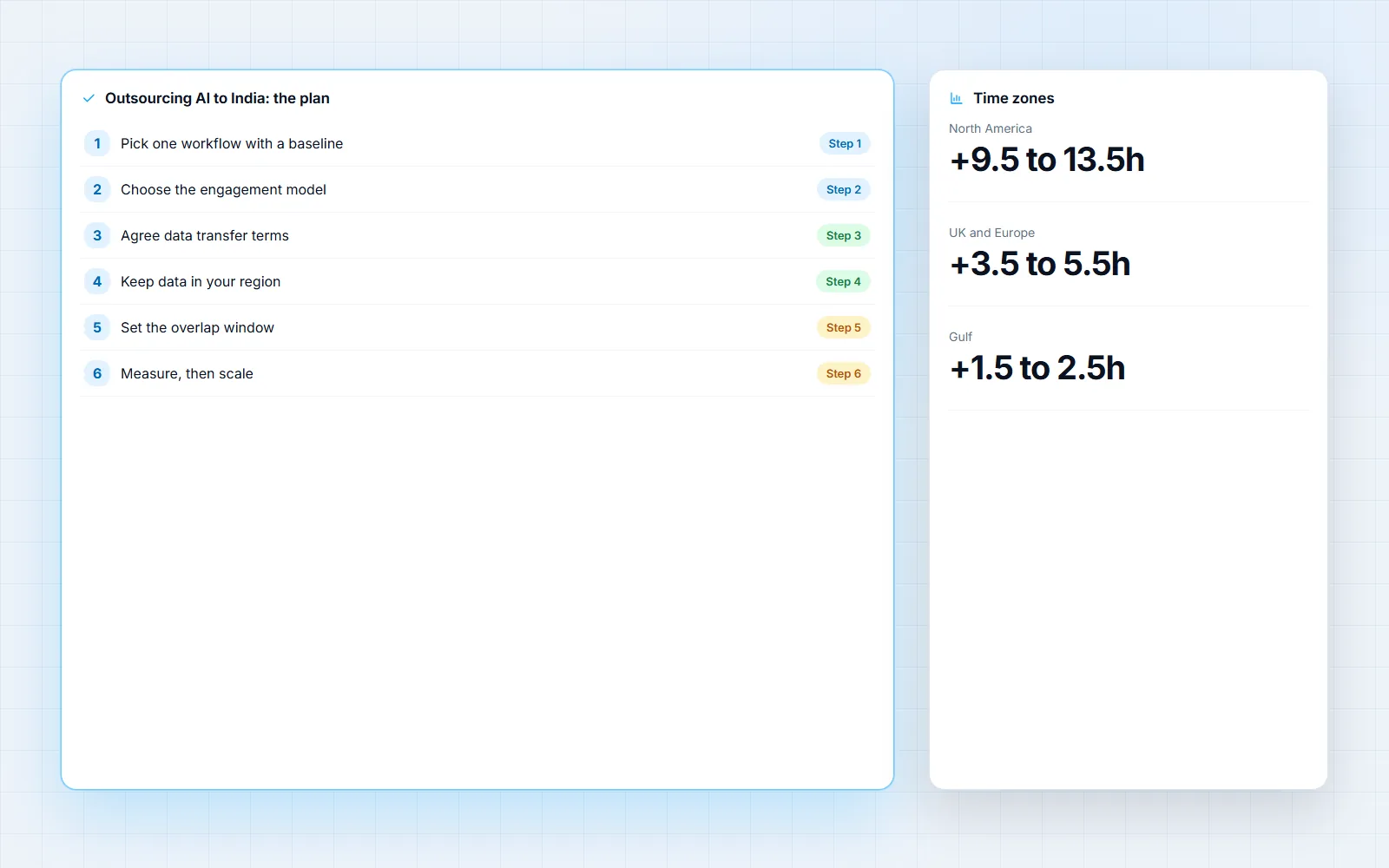
- Time zones. India is 9.5 to 13.5 hours ahead of North America, so work moves forward overnight; 3.5 to 5.5 hours ahead of the UK and Europe, so most of the working day overlaps; and within a few hours of Singapore, the Gulf and Australia.
- Speed. An experienced partner can start within weeks, instead of the months it takes to hire AI engineers locally.
What to outsource first
The best first project is one workflow with a clear baseline, where AI removes repetitive reading, typing or searching: invoice and document processing, customer service requests, internal knowledge search or IT ticket triage. Build it, measure it against the baseline and scale only what works. Our AI agent solutions show common starting points.
Choosing an engagement model
- Fixed-scope project: best for a proof of value or a first agent, with milestones and acceptance criteria agreed upfront.
- Dedicated AI team: best for a long-running roadmap, with engineers working in your tools and rhythm.
- Time and materials: best for exploratory work, with a capped budget and regular demos.
- Build-operate-transfer: best if you want your own team in India eventually. The partner builds and runs it, then transfers it to your entity. See GCC setup in India.
Protecting your data
Data protection is the question every legal team asks first. The rules depend on where you are, and your own advisers should make the final call, but the usual building blocks are these:
- European Union and EEA: under the GDPR, transfers to India usually rely on the EU standard contractual clauses with a transfer impact assessment, because India does not have an adequacy decision.
- United Kingdom: under the UK GDPR, transfers usually rely on the International Data Transfer Agreement or the UK Addendum to the EU clauses.
- Switzerland: under the revised FADP, transfers usually rely on standard contractual clauses adapted for Swiss law.
- Canada: under PIPEDA you stay accountable for personal information sent to a service provider abroad and protect it by contract; Quebec’s Law 25 adds a privacy impact assessment before data leaves the province.
- United States: no general federal rule on offshoring, but sector rules such as HIPAA and state laws such as the CCPA expect proper service-provider contracts.
- Australia, New Zealand and Singapore: privacy laws keep you accountable for data disclosed overseas and expect comparable protection, usually by contract.
- India: the Digital Personal Data Protection Act, 2023 governs personal data processed in India.
The strongest protection is design: keep personal data in your own cloud region, give the offshore team access to code and configuration rather than production data, and use enterprise AI endpoints that do not train on your data.
Making the collaboration work
- One accountable lead on the partner’s side, and one product owner on yours.
- A daily overlap window, such as the North American morning or the European afternoon.
- Written updates and demos every week, against agreed success measures.
- Shared tools: your repository, backlog and chat, so work is visible.
- Evaluation sets for every AI feature, so quality is measured, not argued about.
Red flags
- No AI systems in production to show you.
- Vague answers about which model endpoints will be used and where data is stored.
- No plan for testing accuracy or for what happens when the AI is unsure.
- Pressure to sign a large programme before anything is proven.
- Unclear IP ownership.
How to start
Shortlist two or three partners, ask each the questions in our checklist for choosing an AI development company in India, and start with a small, measured first project. MarkData Consulting is an offshore AI development company in Jaipur, India, working with clients in the US, Canada, the UK, Europe, Australia and the UAE. Book a free consultation to discuss your first AI project.
Is it a good idea to outsource AI development to India?
For many companies, yes: experienced engineers, lower cost and round-the-clock progress. Choose a partner with AI in production, clear data protection and an accountable lead, and start with a measured first project.
How do I protect data when outsourcing AI to India?
Use the transfer mechanism your law requires (such as SCCs or the IDTA), sign a data processing agreement, keep personal data in your own cloud region and use AI endpoints that do not train on your data.
How much does it cost to outsource AI development to India?
It depends on the use case, data, integrations, accuracy targets and engagement model. Ask for a fixed-scope estimate for a first project and an estimate of monthly running costs.
How do time zones work with an Indian AI team?
India is 9.5 to 13.5 hours ahead of North America and 3.5 to 5.5 hours ahead of the UK and Europe. Teams agree a daily overlap window and plan work so progress is ready when your day starts.