India has thousands of companies offering AI development, and most of them can build a convincing demo. Far fewer can take AI into production: connected to real systems, tested for accuracy, secured, measured and supported. This checklist helps you tell the difference before you sign.
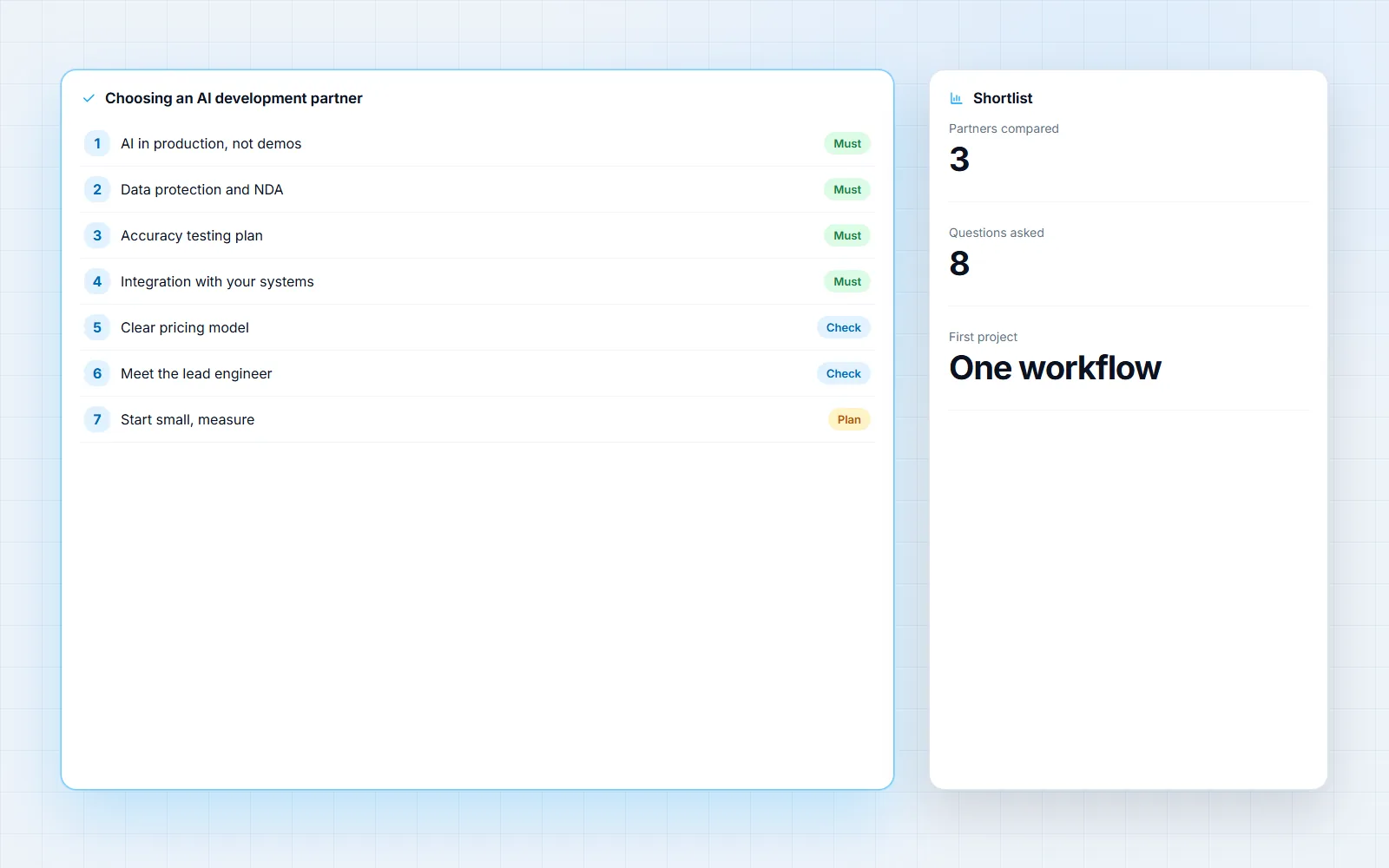
1. Ask for AI in production, not demos
The most important question is simple: show me AI you built that people use every day. Ask what it does, how many users or transactions it handles, how accuracy is measured and who supports it. A partner with production experience will answer in specifics; one without will show you slides and a chatbot.
- Ask for case studies with named clients or clearly described projects, and what the AI actually changed.
- Ask how long the systems have been running and what went wrong along the way.
- Prefer partners who also build ordinary software well. AI in production is mostly integration, data and operations.
2. Check how they protect your data
AI projects touch your most sensitive information: contracts, customer records, financial data. Before any data changes hands, you should know exactly where it goes.
- NDA first. A serious partner signs one before detailed conversations.
- No training on your data. Enterprise model endpoints from the major providers do not train on customer data. Confirm which endpoints will be used.
- Where data is stored. AWS and Azure both have regions in India. Ask whether data stays in the regions you choose.
- India’s data protection law. The Digital Personal Data Protection Act, 2023 applies to personal data processed in India. Ask how the design supports consent, access control and retention.
- IP ownership. The code and models built for you should be yours once you have paid.
3. Ask how they test AI before it goes live
AI is probabilistic, so it needs testing that ordinary software does not. Ask how the partner will prove the system is good enough:
- An evaluation set of real cases from your process, with the right answers, used on every release.
- Accuracy and time-saved targets agreed before the build starts.
- A period of running alongside your team before the AI acts on its own.
- Human approval for anything that changes money, records or what customers see.
4. Check they can integrate with your systems
Most of the value of AI comes from connecting it to the systems where work happens: ERP, CRM, ticketing, document stores, email. Ask which of your systems the partner has worked with, how they connect to them (APIs, databases, standards such as the Model Context Protocol) and how permissions will be scoped so the AI can only do what it should.
5. Understand the pricing model
AI development in India is usually priced in one of three ways:
- Fixed scope for a defined first project, such as a proof of value or a first assistant. Best when the outcome is clear.
- Time and materials when the scope will change as you learn. Best with a capped budget and regular demos.
- A dedicated team for a long-running AI programme, working in your tools and rhythm.
Ask what is included: discovery, evaluation, security review, deployment, training and support. Also ask about running costs after launch, because model usage and hosting are ongoing. Our guide to AI development cost in India explains what drives them.
6. Meet the people who will do the work
Ask to meet the lead engineer, not only the sales team. Check their experience with the models and tools proposed, who will be accountable day to day, how often you will see progress and how quickly they reply. Time-zone overlap matters too: India’s working day covers the European morning and much of the Middle East and Asia, and many teams agree overlap hours with the US.
7. Start small, measure, then scale
The best first AI project is one workflow that matters, with a clear baseline: hours spent, errors made, time to respond. Build it, measure it against the baseline and only then decide what to do next. A partner who pushes for a large programme before anything is proven is a risk.
Questions to ask before you sign
- Which AI systems have you built that are in production today?
- Which model providers and endpoints will you use, and do they train on our data?
- Where will our data be stored and processed?
- How will you measure accuracy, and what happens when the AI is unsure?
- Which of our systems will you integrate, and with what permissions?
- Who owns the code, prompts and models when the project ends?
- What will it cost to run each month after launch?
- Who supports it after go-live, and in what hours?
Where MarkData fits
MarkData Consulting is an AI development company in Jaipur, India, building AI agents, generative AI assistants and machine-learning systems since 2019. Our engineers have built AI and data platforms for Maersk, ION’s Aspect CTRM and OpenText SMAX. We work under an NDA from the first conversation, use enterprise model endpoints that do not train on your data, and agree accuracy targets before we build. Book a free consultation or read about our AI consulting services.
How do I choose an AI development company in India?
Ask for AI in production rather than demos, check how your data is protected, ask how accuracy is tested, confirm they can integrate with your systems, understand the pricing model and meet the people who will do the work.
Is it safe to outsource AI development to India?
Yes, with the right partner and contract: an NDA, enterprise model endpoints that do not train on your data, clear data storage locations, access control and IP assigned to you.
How much does AI development cost in India?
It depends on the use case, data, integrations, accuracy targets and hosting. Most partners quote a fixed scope for a first project or a team-based price for a programme.
How long does an AI project take?
A proof of value usually takes a few weeks. Production rollout follows in stages once the results are measured.