
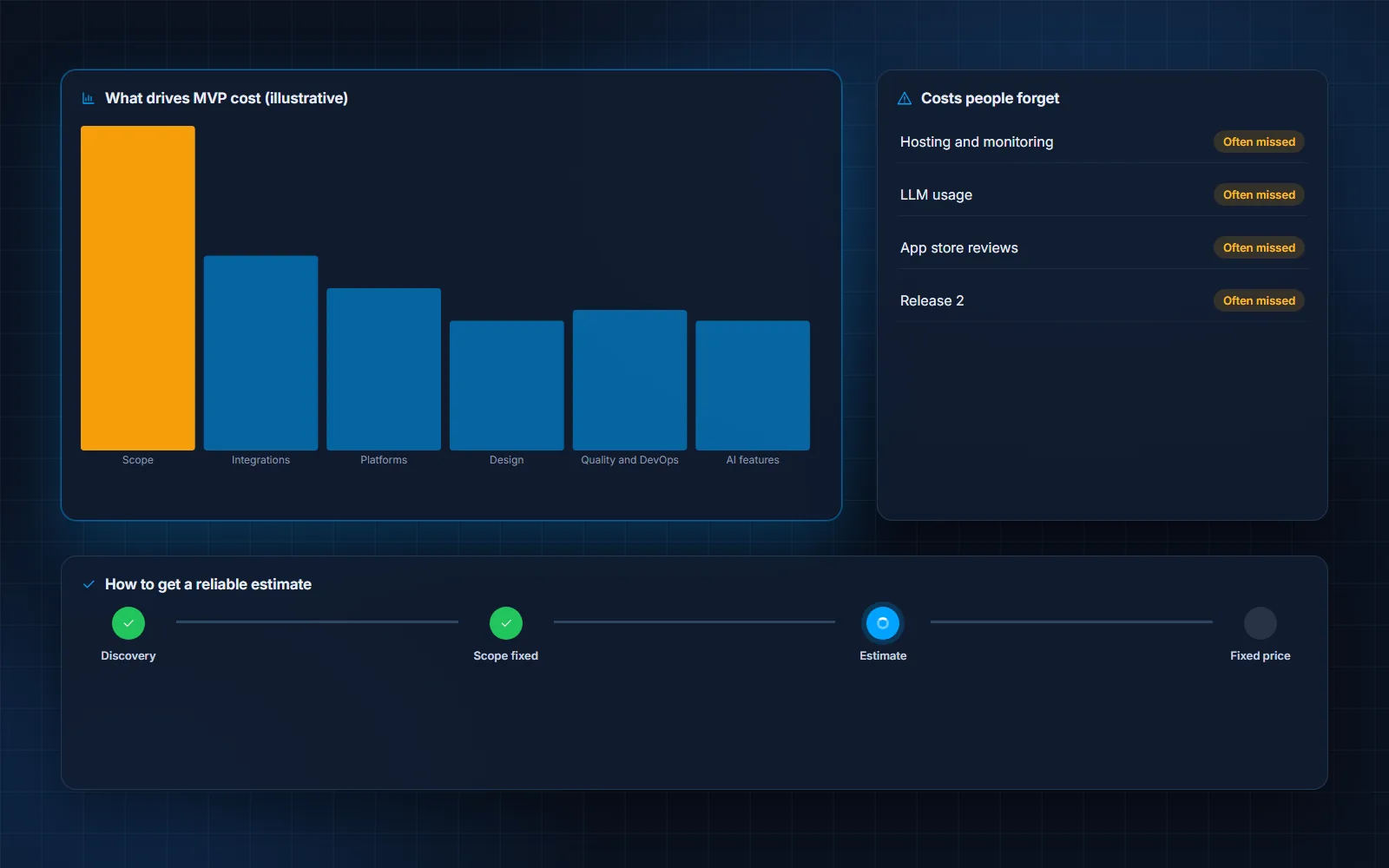
The cost of developing a minimum viable product (MVP) is mostly the size and seniority of the team multiplied by the time it takes to build the agreed scope. Everything that changes the scope or the time, such as features, platforms, integrations, design depth and quality requirements, changes the cost. That is why two MVP quotes for the “same idea” can differ widely.
This guide explains the cost drivers, so you can plan a realistic budget and compare quotes on a fair basis.
The main cost drivers
- Scope: the number of user journeys and features. Each extra role, workflow or report adds design, build and test effort.
- Platforms: web only, mobile only, or both. A cross-platform mobile app costs less than two native apps.
- Integrations: payments, CRM, ERP, maps, identity providers and partner APIs each add effort and testing.
- Design: a simple UI kit is cheaper than custom branding, illustrations and extensive user testing.
- AI features: LLM assistants and agents need prompt design, evaluation and guardrails, plus ongoing model costs.
- Data and security: sensitive data, compliance and enterprise sign-on add architecture and testing work.
- Team and location: seniority, team size and where the team is based all change the cost per month.
How an MVP estimate is built
- Break the scope into user stories or features.
- Estimate design, development and testing effort for each.
- Add project management, DevOps and release work.
- Add contingency for unknowns, more if the scope is still vague.
- Convert effort into a team and a timeline, which gives the budget.
Costs people forget
- Cloud hosting, monitoring and third-party services after launch.
- App store accounts and review cycles for mobile apps.
- LLM usage costs for AI features.
- Maintenance, security updates and bug fixes.
- Analytics and the second release that follows real user feedback.
How to keep MVP costs under control
- Start with discovery. A short workshop that fixes the scope prevents expensive changes later.
- Cut ruthlessly. Build the smallest product that tests your riskiest assumption.
- Use proven building blocks: managed cloud services, authentication providers and UI component libraries.
- Choose cross-platform for mobile unless you need native performance.
- Fix the scope, then fix the price for the first release.
Comparing MVP quotes
When quotes differ, compare what is included: the same scope, design depth, testing, DevOps, documentation and support after launch. A low quote that leaves out testing or hosting usually costs more in the end.
Frequently asked questions
How much does it cost to build an MVP?
It depends on scope, platforms, integrations, design and the team. A short discovery turns an idea into a scope precise enough for a reliable estimate.
How long does MVP development take?
Typically weeks to a few months. Larger scopes, several platforms and many integrations take longer.
Is it cheaper to build an MVP in India?
Team costs in India are generally lower than in North America or Western Europe, but compare the total cost of delivery, including quality and communication, not just rates.
Should an MVP include AI?
Only where AI is central to the value you are testing. Otherwise, add it in a later release.
Ready to scope yours? See our MVP development service or book a product discovery workshop.