
A global capability centre (GCC) is an offshore centre that a company owns and runs itself to deliver technology, engineering, data, AI or business services for the whole organisation. India is the world’s largest GCC market, and a growing number of companies are setting up beyond the largest metros. This guide explains how to set up a GCC in Jaipur, step by step: why Jaipur, which operating model to choose, what the set-up involves, how long it takes and the mistakes to avoid.
What is a GCC?
A GCC, also called a global capability center, global in-house centre or captive centre, is part of the parent company rather than a supplier. Its people are the company’s own employees, it works on the company’s own products and processes, and the intellectual property it creates stays inside the business. That is the main difference from outsourcing, where a vendor delivers a service under contract, and from an offshore development centre (ODC), where a vendor provides a dedicated team that remains the vendor’s staff.
Early GCCs focused on IT support and back-office work. Today they build products, run cloud platforms, own data and AI programmes and lead global functions. According to Nasscom and Zinnov, India now hosts more than 2,000 GCCs employing well over two million people.
Why set up a GCC in India?
- Talent at scale: experienced engineers in Java, Python, cloud, data, AI and QA, and the ability to keep growing the team.
- Cost: salary and operating costs well below North America and Western Europe, so the same budget builds a larger or more senior team.
- Ownership: unlike outsourcing, knowledge, culture and IP stay inside the company.
- Time zones: a working day that overlaps with Europe and the Middle East and gives teams in the Americas progress overnight.
- Open rules for investment: India allows 100% foreign direct investment in IT and IT-enabled services under the automatic route.
Why Jaipur for your GCC?
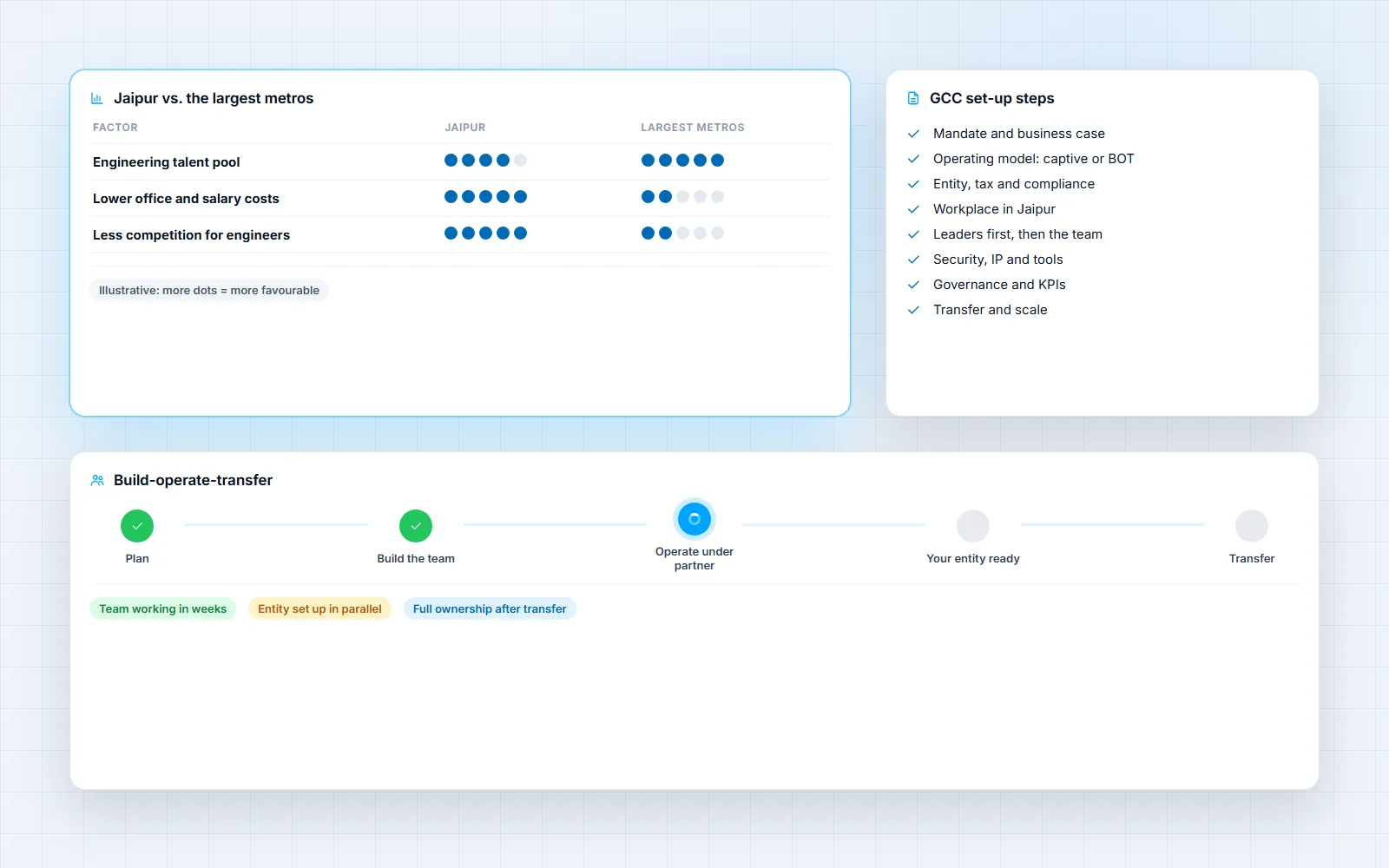
Bengaluru, Hyderabad, Pune, Chennai, Mumbai and Delhi NCR still host most of India’s GCCs, which also means the fiercest competition for engineers and the highest costs. Jaipur, the capital of Rajasthan, is one of the cities companies now look at for their next centre.
- Engineering talent: Jaipur’s universities and engineering colleges, including MNIT Jaipur and LNMIIT, produce engineers every year, and many professionals who left for the metros want to work closer to home.
- Lower costs and steadier teams: office rents and salaries are lower than in the largest metros, and there is less competition from hundreds of other GCCs hiring the same people.
- Established IT infrastructure: Mahindra World City Jaipur is a large multi-product special economic zone with a dedicated IT zone, where companies such as Infosys and Wipro set up early, alongside commercial offices across the city.
- Connectivity: an international airport, and road and rail links to Delhi a few hours away.
- State support: Rajasthan has a dedicated policy to attract GCCs (see below).
Rajasthan's GCC Policy
In 2025 the Government of Rajasthan approved a Global Capability Centre Policy to make the state a destination for GCCs, with Jaipur as a main hub. The policy is valid until March 2029. It offers support such as capital subsidy, operational support and workforce incentives, alongside the Rajasthan Investment Promotion Scheme (RIPS-2024), and applications are processed through the RajNivesh single-window portal. Eligibility, amounts and caps are set out in the notified policy, so check the current terms with the state government before you build them into your business case.
Choose your operating model
- Own entity from day one (captive): you register an Indian company, lease an office and hire directly. Most control, but the slowest and riskiest start, especially in a city where you have no network.
- Build-operate-transfer (BOT): a partner already in the city hires and runs your team under its own entity and office, to your standards. When your entity is ready, the people, processes and assets transfer to you. A fast start with lower risk, and full ownership later.
- Hybrid: you set up the entity and leadership yourself, and a partner handles hiring, operations or specific functions until your team is established.
Many companies, especially mid-sized ones setting up their first GCC, choose build-operate-transfer because the team starts delivering while the legal and real-estate work happens in parallel.
How to set up a GCC in Jaipur: step by step
- 1. Define the mandate and business case. Which work moves to the GCC, which skills you need in years one to three, the target size, budget and the measures of success.
- 2. Choose the operating model and partner. Captive, build-operate-transfer or hybrid, and, if you use a partner, the terms for transfer agreed upfront.
- 3. Set up the legal entity and compliance. With your legal and tax advisers: company or branch registration, tax registrations, employment and labour registrations, transfer pricing and banking. On a BOT model this runs in parallel while the team already works.
- 4. Find the workplace. An SEZ, a technology park or a commercial office, depending on incentives, scale and how you serve the parent company. Start in a partner’s office or flexible space if you need to.
- 5. Hire leaders first. A centre head and engineering leads who know your domain set the culture and make every later hire easier.
- 6. Build the team. Hire in waves, onboard with the parent company’s engineers, and pair new joiners with people who know the systems.
- 7. Put security, IP and tools in place. NDAs and IP assignment, access control, secure laptops and networks, cloud access, and the same engineering tools and standards as headquarters.
- 8. Run it with clear governance. Delivery KPIs, cost reporting, regular steering with headquarters and a plan for the next capabilities the centre will take on.
- 9. Transfer and scale. On a BOT model, move people, contracts and assets to your entity, then grow the centre’s mandate.
How long does it take to set up a GCC?
With your own entity, expect many months before the first team is productive: entity registration, office fit-out and senior hiring all take time. On a build-operate-transfer model, a first team can start within weeks under the partner’s entity, and the transfer to your own entity typically follows within one to three years, at a pace you agree.
What drives the cost of a GCC?
- Team size, seniority and skill mix, which are by far the largest cost.
- Office space, fit-out and facilities.
- Technology, security and tools.
- Legal, tax, compliance and payroll administration.
- Partner fees on a BOT or hybrid model, and the agreed transfer terms.
- Travel and time from the parent company’s leaders, especially in the first year.
Common mistakes to avoid
- Moving low-value work only, so the best engineers never join or stay.
- Hiring the team before the leaders.
- Treating the GCC as a vendor instead of part of the company.
- No clear KPIs or steering, so nobody can show the value.
- Leaving security, IP and access to be sorted out later.
- Choosing a location on cost alone, without checking the talent you need is there.
How MarkData helps you set up a GCC in Jaipur
MarkData Consulting has run engineering teams from Jaipur since 2019 for enterprise clients in commodity trading, shipping and IT service management. Our GCC setup service helps you plan the centre, hire the team and run it on a build-operate-transfer model, then transfer it to your own entity, working alongside your legal, tax and real-estate advisers. Read more about our software company in Jaipur or book a free consultation to discuss your GCC.
Frequently asked questions
What is a GCC?
A global capability centre (GCC) is an offshore centre owned by a company that delivers technology, engineering, data, AI or business services for the whole organisation. Its people are the company's own employees, unlike outsourcing.
Is Jaipur a good location for a GCC?
For many companies, yes. Jaipur offers engineering talent, lower costs and less competition for staff than the largest metros, IT infrastructure such as Mahindra World City, an international airport and a state GCC policy. Check that the specific skills you need are available at the scale you plan.
How long does it take to set up a GCC in India?
With your own entity, many months before the first team is productive. On a build-operate-transfer model, a team can start within weeks under a partner's entity, with the transfer to your own entity following later.
What is the build-operate-transfer (BOT) model?
A partner builds and runs your offshore team under its own entity, then transfers the people, processes and assets to your company once your entity is ready. It reduces set-up time and risk.
Do I need an Indian legal entity to start a GCC?
Not on day one. On a build-operate-transfer model the team starts under the partner's entity while you set up your own. For a captive centre you need your own entity, usually a private limited company or a branch.
Does Rajasthan offer incentives for GCCs?
Yes. Rajasthan's GCC Policy 2025 offers support such as capital subsidy, operational support and workforce incentives, alongside RIPS-2024. Eligibility and amounts are set in the notified policy, so confirm the current terms with the state government.
Related reading: outsourcing software development to India; how to choose a software development company in India.