
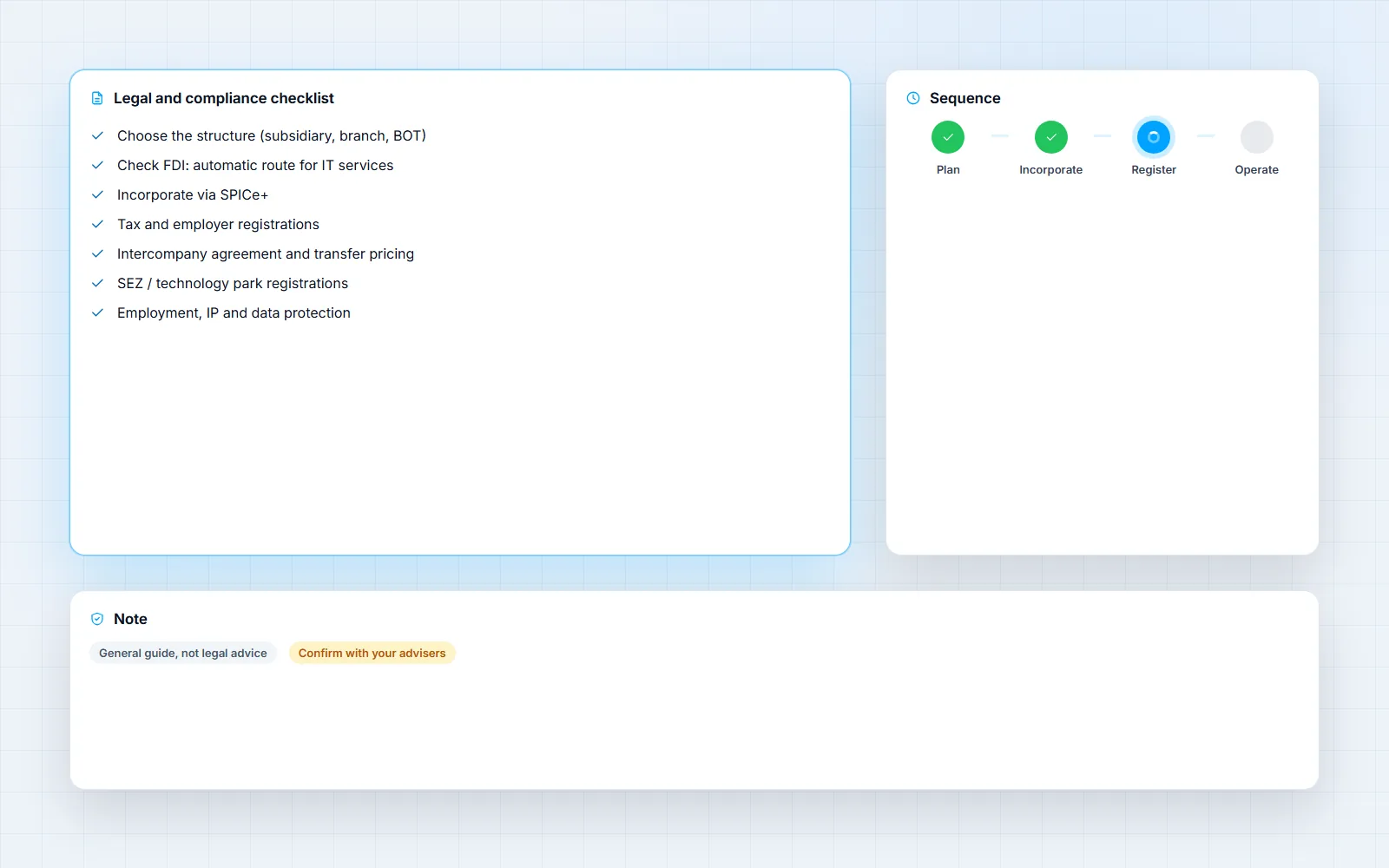
Setting up a global capability centre (GCC) in India usually means incorporating an Indian subsidiary, registering it for tax and employment, and putting intercompany agreements and transfer pricing in place. This guide gives an overview of the main steps so you can plan with your advisers. It is general information, not legal or tax advice.
1. Choose the legal structure
- Wholly owned subsidiary (private limited company): the most common choice for a GCC. It is an Indian company owned by the parent, incorporated under the Companies Act, 2013.
- Branch office: an extension of the foreign company, subject to Reserve Bank of India rules on permitted activities.
- Limited liability partnership (LLP): possible in some cases, but less common for GCCs.
- Start on a partner’s entity (build-operate-transfer): the team works under the partner’s company while yours is set up.
2. Check foreign investment rules
India allows 100% foreign direct investment in IT and IT-enabled services under the automatic route, so no prior government approval is needed for most technology GCCs. After shares are issued to the parent, the investment is reported to the Reserve Bank of India (Form FC-GPR) within the set deadline.
3. Incorporate the company
- Appoint directors: a private company needs at least two, and at least one must be resident in India.
- Reserve the company name and prepare the constitutional documents.
- File the incorporation through the Ministry of Corporate Affairs’ SPICe+ form, which also covers PAN and TAN and several employer registrations.
- Provide a registered office address in India and open a bank account.
4. Register for tax and employment
- GST registration where required for your services.
- State registrations such as the shops and establishments registration for the office.
- Provident fund (EPF) and employees’ state insurance (ESI) where the thresholds apply.
- Payroll set-up, including tax deduction at source on salaries.
5. Put intercompany agreements and transfer pricing in place
The GCC provides services to its parent, so the two companies need a services agreement, and the price must be at arm’s length under India’s transfer pricing rules. Many GCCs are remunerated on a cost-plus basis; India also offers safe harbour and advance pricing agreements that can reduce disputes. Your tax advisers should design this before the first invoice.
6. Workplace, incentives and special zones
If you set up in a special economic zone or register with a technology park scheme, extra approvals and reporting apply, along with any benefits. State policies, such as Rajasthan’s GCC policy, have their own eligibility rules and application processes.
7. Employment, IP and data protection
- Employment contracts and policies that follow Indian labour law.
- Clear assignment of intellectual property from employees to the company, and from the company to the parent where needed.
- Data protection in line with India’s Digital Personal Data Protection Act and the data protection laws that apply to the parent’s data.
- Information security policies, access control and audits.
Common pitfalls
- Starting hiring before the employer registrations are in place.
- Leaving transfer pricing until the first audit.
- Unclear IP assignment between employees, the Indian entity and the parent.
- Assuming state incentives apply without checking the conditions.
Frequently asked questions
Does a foreign company need approval to set up a GCC in India?
For most IT and IT-enabled services, no prior government approval is needed, because 100% foreign direct investment is allowed under the automatic route. Reporting to the Reserve Bank of India still applies.
What is the best legal structure for a GCC in India?
Most GCCs are set up as a wholly owned private limited subsidiary. Some start under a partner's entity on a build-operate-transfer model.
How long does incorporation take?
Incorporation itself can be quick once documents are ready; bank accounts, registrations and office set-up take longer. Plan the whole sequence with your advisers.
Can we start before our entity is ready?
Yes, on a build-operate-transfer model, where the team starts under a partner's entity and transfers to yours later.
This guide is general information; confirm each step with your legal and tax advisers. To start delivering while your entity is set up, see our GCC setup service and the GCC cost guide.