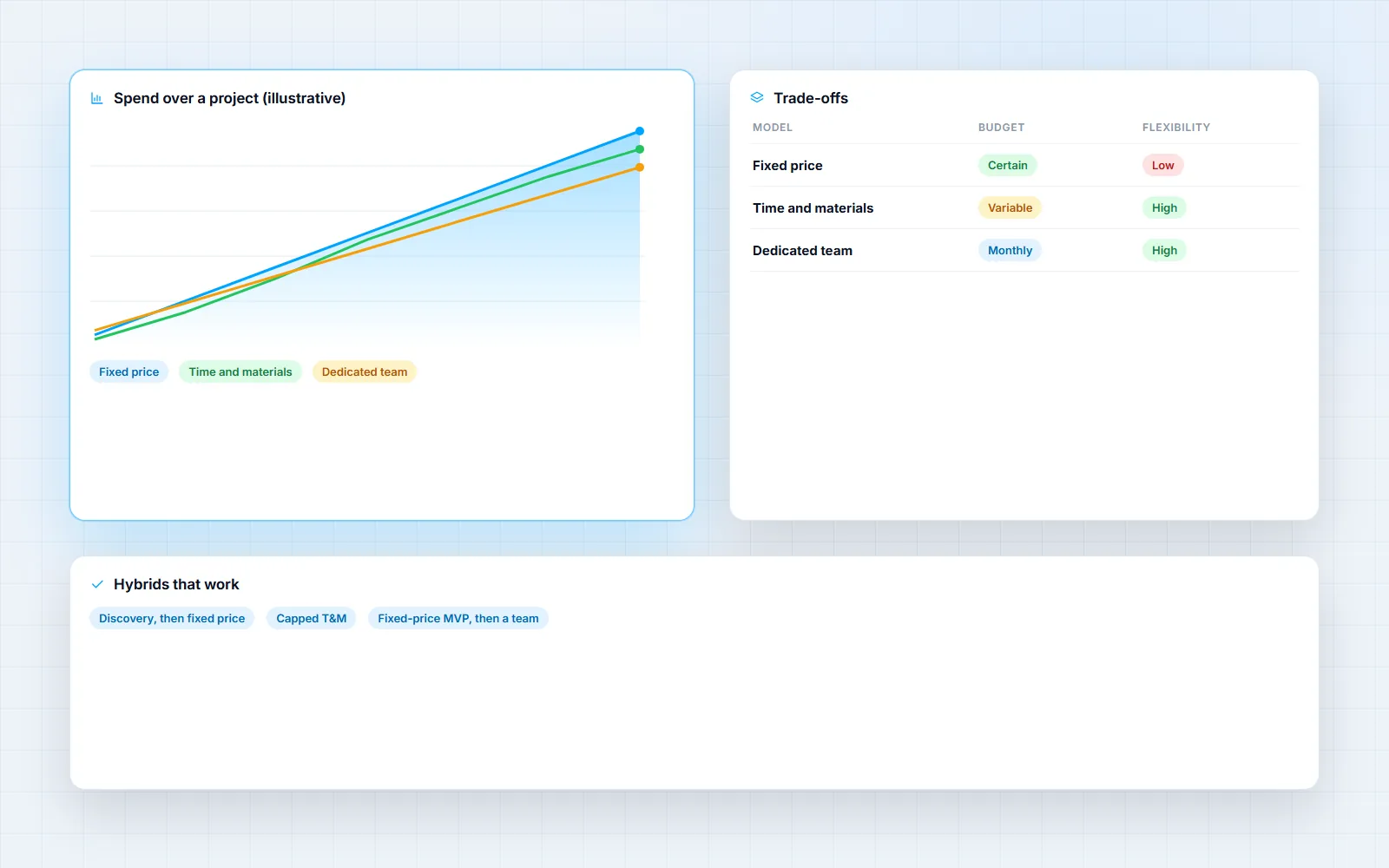
A fixed-price contract buys an agreed scope for an agreed price. Time and materials (T&M) pays for the actual effort spent, so scope can change as you learn. A dedicated team gives you a stable team for a period, at a predictable monthly cost. Each model shares risk differently between you and your software partner.
Fixed price
The partner estimates the work from a detailed scope and commits to delivering it for a set price, usually with milestones and acceptance criteria.
- Pros: a known budget, clear deliverables and delivery risk carried by the partner.
- Cons: needs a detailed scope upfront; every change becomes a change request; partners add contingency to cover risk.
- Best for: well-understood projects, MVPs after a discovery phase, and fixed-budget initiatives.
Time and materials
You pay for the hours or days worked, at agreed rates, and steer priorities as the project progresses. Budgets are controlled through estimates, caps and regular reviews.
- Pros: flexibility to change scope, no contingency premium, and you only pay for work done.
- Cons: the final cost is less certain; needs active involvement from your side.
- Best for: evolving products, research-heavy work such as AI, and projects where requirements will change.
Dedicated team
A team of agreed size and skills works only on your product for a period, managed with you. Cost is predictable per month, and priorities can change every sprint.
- Pros: predictable monthly cost, knowledge that builds up, and full flexibility on priorities.
- Cons: you need a backlog and product direction to keep the team busy.
- Best for: long-running products and roadmaps.
Hybrid approaches that work well
- Discovery, then fixed price: a short paid discovery produces a scope precise enough for a fair fixed price.
- Capped T&M: time and materials with a budget ceiling and checkpoints.
- Fixed-price MVP, then a dedicated team: a defined first release, followed by a team that grows the product.
How to choose
- How well defined is the scope today? Clear means fixed price; unclear means T&M or discovery first.
- How much will requirements change once users see the software? A lot means T&M or a dedicated team.
- How much time can your people give the project? Little time favours fixed price with clear acceptance.
- Is this a one-off project or a product with a roadmap? A product favours a dedicated team.
Frequently asked questions
Is fixed price cheaper than time and materials?
Not always. Fixed-price quotes include contingency for risk, while time and materials charges only for work done. Fixed price buys certainty, not necessarily a lower total.
What is a time and materials contract?
A contract where you pay for the actual time spent and any materials, at agreed rates, with scope and priorities adjusted as the project goes.
Can a fixed-price project change scope?
Yes, through change requests that adjust price and timeline. Frequent changes are a sign that time and materials would fit better.
Which model is best for an MVP?
A short discovery followed by a fixed-price MVP works well, then a dedicated team or time and materials to grow the product.
See how we work in our engagement models, or start with a discovery workshop.