
Angular is a complete, opinionated framework; React is a flexible library for building user interfaces. Both are mature, fast and used in large enterprise applications, so the right choice depends less on raw capability and more on your team, your existing code and how much structure you want the framework to impose.
Our engineers build and maintain both every day, from trading screens in Angular to customer portals in React. Here is how we help clients choose.
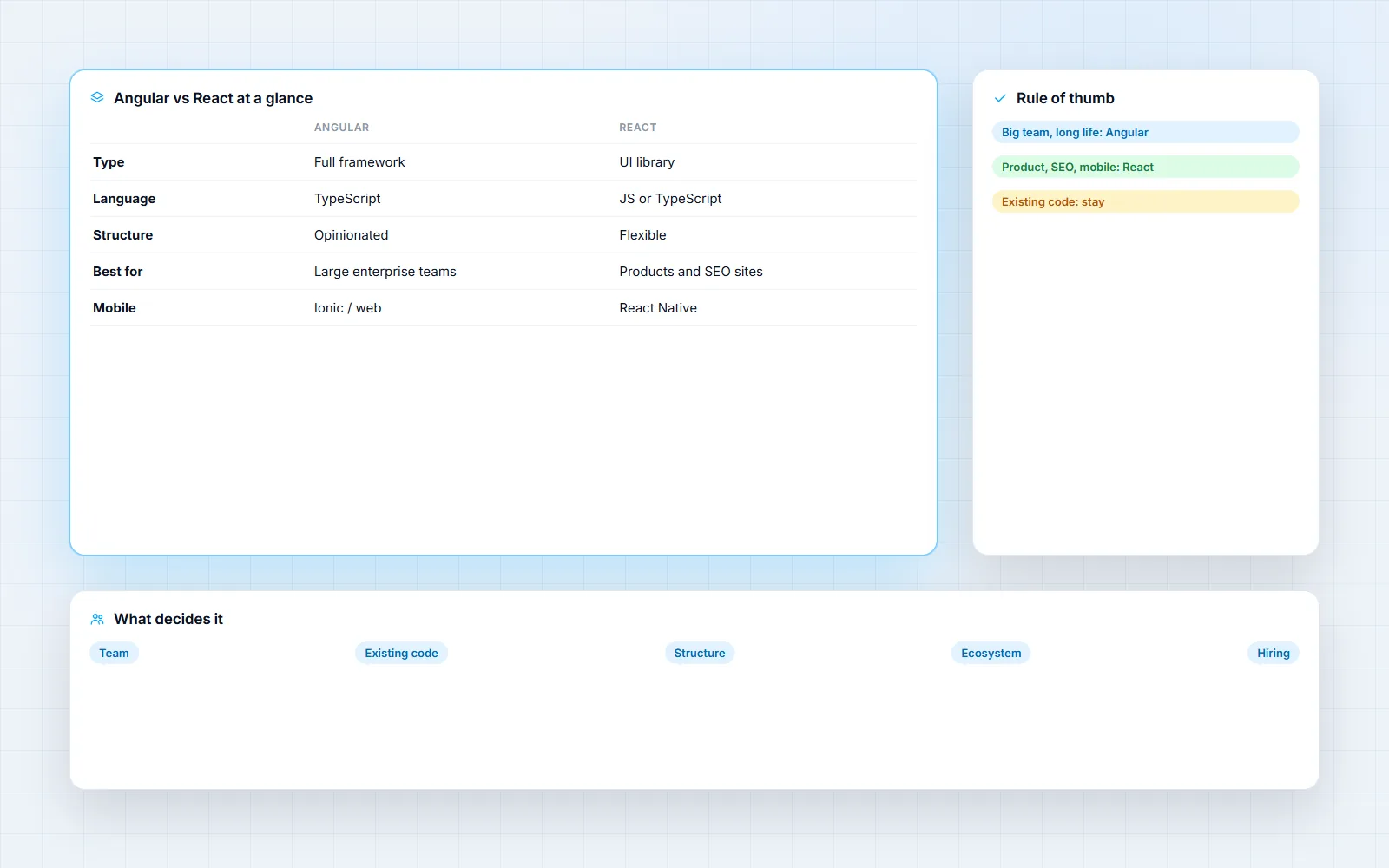
Angular vs React at a glance
- Type: Angular is a full framework from Google with routing, forms, HTTP and dependency injection built in. React, from Meta, is a UI library; routing, data fetching and state come from the wider ecosystem or a framework such as Next.js.
- Language: Angular uses TypeScript by default. React works with JavaScript or TypeScript, and most enterprise teams now choose TypeScript.
- Structure: Angular gives every project the same structure, which helps large teams. React leaves architecture decisions to the team, which gives flexibility but needs discipline.
- Reactivity: Angular uses RxJS and, in recent versions, signals. React uses hooks and a virtual DOM, with server components available through frameworks.
- Learning curve: Angular takes longer to learn but less to decide. React is quicker to start but needs more choices about libraries and patterns.
When Angular is the better choice
- Large enterprise applications with many developers who benefit from one consistent structure.
- Teams coming from Java or .NET, who find Angular’s dependency injection and modules familiar.
- Data-heavy internal applications such as trading screens, back-office tools and admin portals.
- Organisations that want fewer third-party dependencies and a single upgrade path.
When React is the better choice
- Customer-facing products where flexibility, design freedom and a large component ecosystem matter.
- Sites that need server-side rendering for SEO and speed, using Next.js.
- Teams that want to share skills with React Native for mobile apps.
- Start-ups and product teams that move fast and choose their own architecture.
Performance
For business applications, both are fast enough when used well. Real-world performance problems usually come from data loading, oversized bundles and unnecessary re-rendering, not from the framework. Lazy loading, sensible state management and performance budgets matter more than the choice between Angular and React.
Hiring and long-term maintenance
React has the larger developer community, which makes hiring easier in most markets. Angular developers tend to have stronger enterprise experience, and Angular’s consistency makes it easier for a new developer to understand an unfamiliar codebase. Either way, the deciding factor for maintenance is code quality: tests, typed models and clear component boundaries.
What about existing applications?
If you already have a large Angular or React codebase, staying with it is usually the right decision. Migrating between them is expensive and rarely pays back. The common exception is old AngularJS (version 1), which is no longer supported and should be upgraded to modern Angular or rebuilt in React, screen by screen.
Our recommendation
Choose Angular for large, long-lived enterprise applications built by bigger teams that value structure. Choose React for customer-facing products, SEO-sensitive sites and teams that want flexibility or plan a React Native mobile app. If you are unsure, we can review your requirements and team in a short discovery workshop.
Frequently asked questions
Is Angular or React better for enterprise applications?
Both are used in large enterprise applications. Angular suits big teams that want one consistent structure; React suits teams that want flexibility and a larger ecosystem.
Is React faster than Angular?
For typical business applications the difference is small. Data loading, bundle size and rendering patterns matter far more than the framework.
Which is easier to learn, Angular or React?
React is quicker to start with. Angular takes longer to learn but makes more decisions for you, which helps larger teams.
Should we migrate from Angular to React?
Usually not. Migration is costly and rarely pays back. Upgrading old AngularJS applications is the main exception.
Need help? See our web app development services, or hire Angular developers and hire React developers from our Jaipur team.