
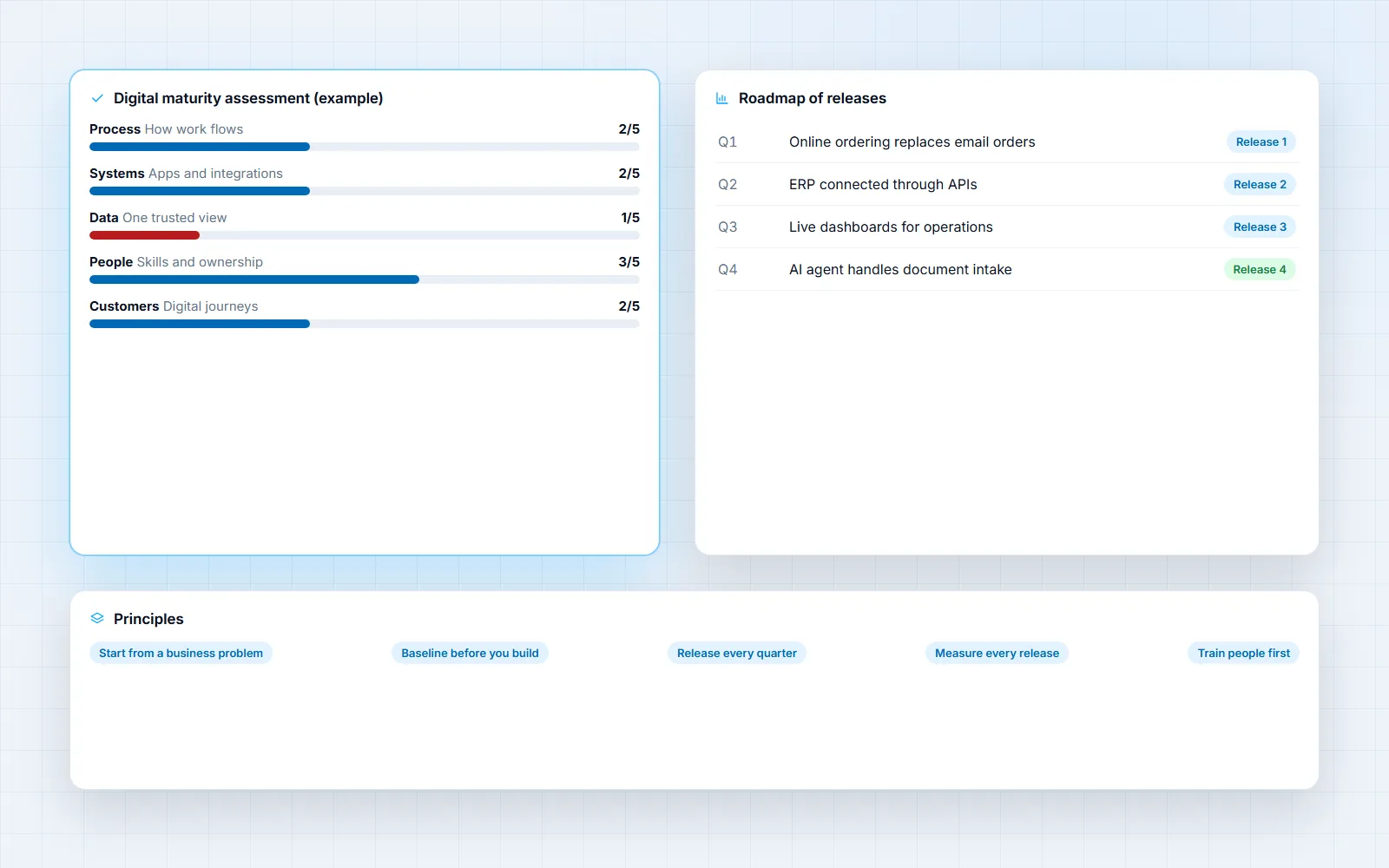
Digital transformation means changing how a business works by using technology: how orders arrive, how decisions are made, how customers are served and how data flows between teams. It is not the same as buying new software. Companies that treat it as a technology purchase usually end up with new tools and old problems.
Here is a practical playbook for a strategy that delivers in steps you can measure.
Why digital transformation strategies fail
- They start from technology trends rather than business outcomes.
- They are planned as one big programme, which loses momentum and budget before it delivers.
- Nobody records a baseline, so nobody can show what improved.
- People are trained last, so the new systems are used like the old ones.
The five areas a strategy must cover
- Process: how work flows today, where it waits and where it is re-keyed.
- Systems: the applications you run, how they connect and which ones block change.
- Data: whether there is one trusted view of customers, orders, stock and money.
- People: skills, ownership and the appetite for change.
- Customers: the digital journeys they expect, from ordering to support.
Building the strategy in six steps
- 1. Agree the business outcomes. Faster order-to-cash, lower cost to serve, new digital revenue, better compliance. Pick three at most.
- 2. Assess maturity and set a baseline. Score each of the five areas and measure the processes behind your outcomes.
- 3. Choose the value streams to change first. Usually the processes with the most manual work or customer impact.
- 4. Design the target architecture. Systems connected through APIs, workloads on the cloud where it makes sense, one data model for reporting, and a place for AI.
- 5. Plan releases, not a programme. Each release changes something users notice within a quarter.
- 6. Govern and measure. Review every release against the baseline and re-plan the next one.
Modernising legacy systems
Legacy applications are often the biggest blocker. There are five common options, and most programmes use several of them:
- Retain: keep the system and wrap it with APIs.
- Rehost: move it to the cloud as it is, to cut hosting costs and risk.
- Replatform: move it to managed services, such as a managed database or containers.
- Refactor: split it into services gradually, starting with the parts that change most. Our OpenText SMAX case study shows this approach.
- Replace: buy or build a new system where the old one no longer fits the business.
We cover these options on our legacy application modernisation and cloud pages.
Where AI fits
AI belongs in a transformation strategy, but as a means, not the goal. It works best once processes and data are in reasonable shape: reading incoming documents, triaging requests, forecasting demand, recommending prices. Our AI transformation roadmap explains how to choose and prove AI use cases.
KPIs that show progress
- Cycle time of the processes you targeted (for example order-to-cash).
- Share of transactions handled without manual re-keying.
- Cost to serve per customer or per order.
- Time to produce key reports.
- Adoption: active users of the new systems and journeys.
Frequently asked questions
What is the difference between digitisation and digital transformation?
Digitisation turns paper or manual steps into digital ones. Digital transformation changes the process and the business model around them.
How much does digital transformation cost?
It depends on scope. Planning in releases lets you fund and prove each step before committing to the next.
Do we need consultants for digital transformation?
Not always. Outside help is most useful for the assessment, the target architecture and the engineering capacity to deliver releases quickly.
How do we keep a transformation on track?
Short releases, a baseline for every target process, and a monthly review of results against it.
MarkData combines digital transformation consulting with the engineering to deliver it. See our digital transformation services or talk to us about your plans.