Most companies now have AI pilots. Far fewer have AI that changes how the business runs. The gap is rarely the technology. It is the lack of a roadmap that connects business priorities, data, governance and delivery, so that the best ideas reach production and the rest are stopped early.
This is the roadmap we use with clients. The timings are an example for a mid-sized business; the order of the phases matters more than the weeks.
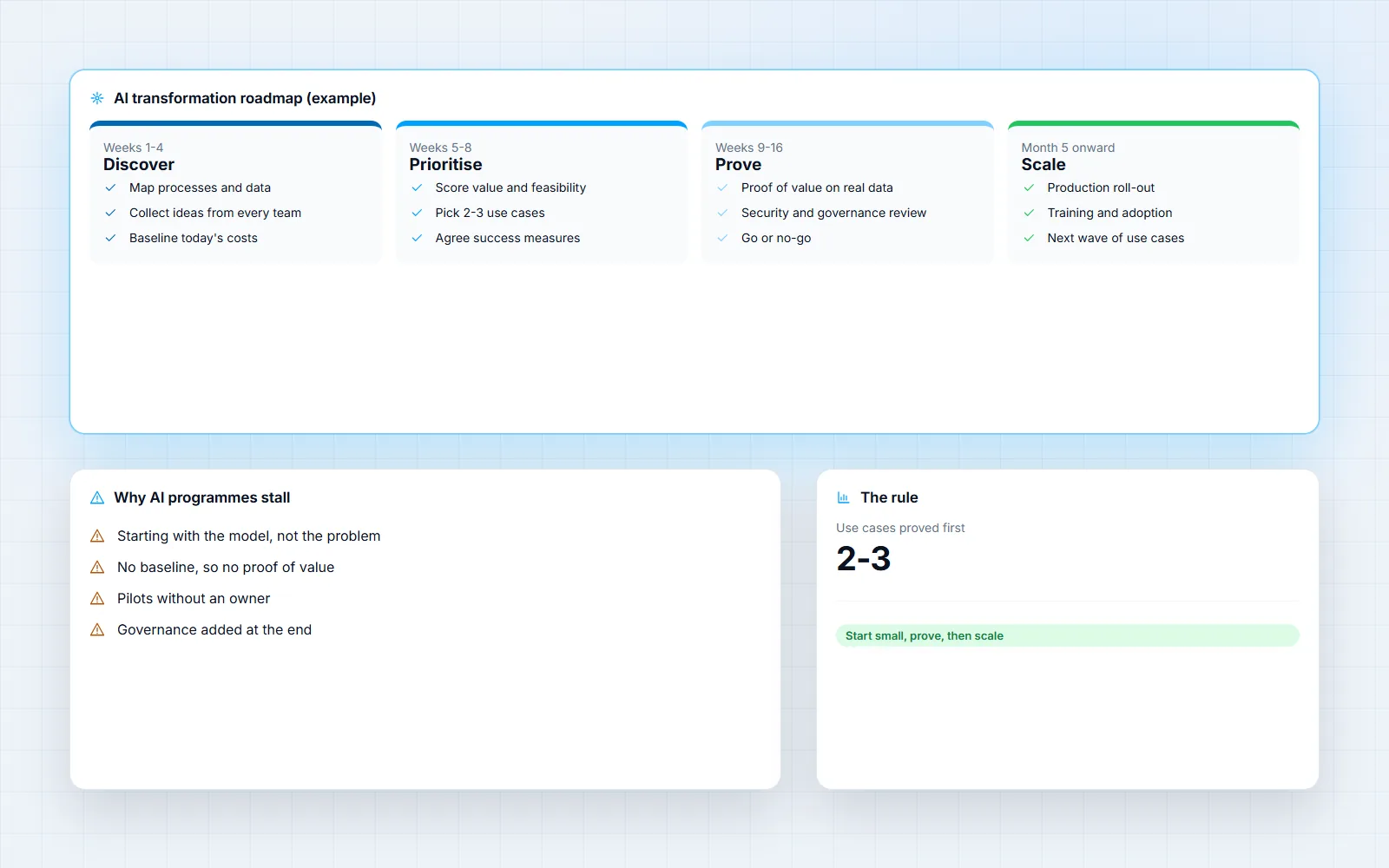
Phase 1: Discover (about 4 weeks)
Start with the work, not the models. Interview the teams that carry the heaviest manual load: finance operations, customer service, sales support, IT, compliance. Map where time goes, where errors happen and where decisions wait for information.
- Collect use-case ideas from every team, in their own words.
- Record a baseline for each candidate process: volume, time per case, error rate, cost.
- List the data and systems each idea depends on, and who owns them.
Phase 2: Prioritise (about 4 weeks)
Score every idea on three axes:
- Value: hours saved, revenue protected, errors avoided, measured against the baseline.
- Feasibility: are the data and systems accessible, and is the task one AI does well today?
- Risk: what happens if the AI is wrong, and can a person catch it in time?
Choose two or three use cases with high value, good feasibility and manageable risk. Write a one-page business case for each, with the success measure that will decide whether it scales.
Phase 3: Prove (about 8 weeks)
Build a proof of value on real data, not a demo on samples. Run it alongside the current process, compare results against the baseline, and review security, privacy and governance before anything touches production. End with an honest go or no-go decision. Stopping a use case that does not pay is a success of the process, not a failure.
Phase 4: Scale (month 5 onward)
- Move the proven use cases to production with monitoring, support and owners.
- Train the people whose work changes, and adjust the process around the AI.
- Start the next wave from the ranked list, reusing the platform and controls you have built.
The foundations to put in place
- A model gateway so teams can use several AI providers, control cost and switch models without rewriting applications.
- Data access with permissions carried across, so AI only sees what each user is allowed to see.
- Governance: an AI policy, a register of use cases, evaluation before release and an audit trail. See AI governance and security.
- Skills: a small central team that sets standards, with engineers embedded in business teams to deliver.
Measuring return on AI
Measure what the business already cares about: cost per transaction, cycle time, error rate, revenue per salesperson, customer response time. Compare against the baseline from phase 1, and include the running cost of the AI itself: model usage, hosting and the people who supervise it.
Common reasons AI transformations stall
- Starting with a model or a vendor instead of a business problem.
- No baseline, so nobody can prove the value.
- Pilots with no business owner, which stop when the enthusiast moves on.
- Governance added at the end, which blocks the release.
- Treating AI as an IT project rather than a change in how people work.
Frequently asked questions
How long does an AI transformation take?
The first use cases can be proved within a few months. The transformation itself is ongoing: each wave of use cases builds on the platform, data and skills of the last.
Do we need a data platform before we start with AI?
Not usually. Many first use cases run on documents, emails and tickets. A data platform becomes important as AI moves into forecasting, pricing and analytics.
Should we build or buy AI?
Buy where a product fits a common process well. Build where the process is what sets you apart, or where you need control over data and behaviour.
Who should own AI in the organisation?
Each use case needs a business owner. A small central team should own standards, the platform and governance.
MarkData helps companies go from AI ideas to AI in production, with the same team doing the strategy and the engineering. See our AI consulting and transformation services or book a free consultation.