04
Jun 2026
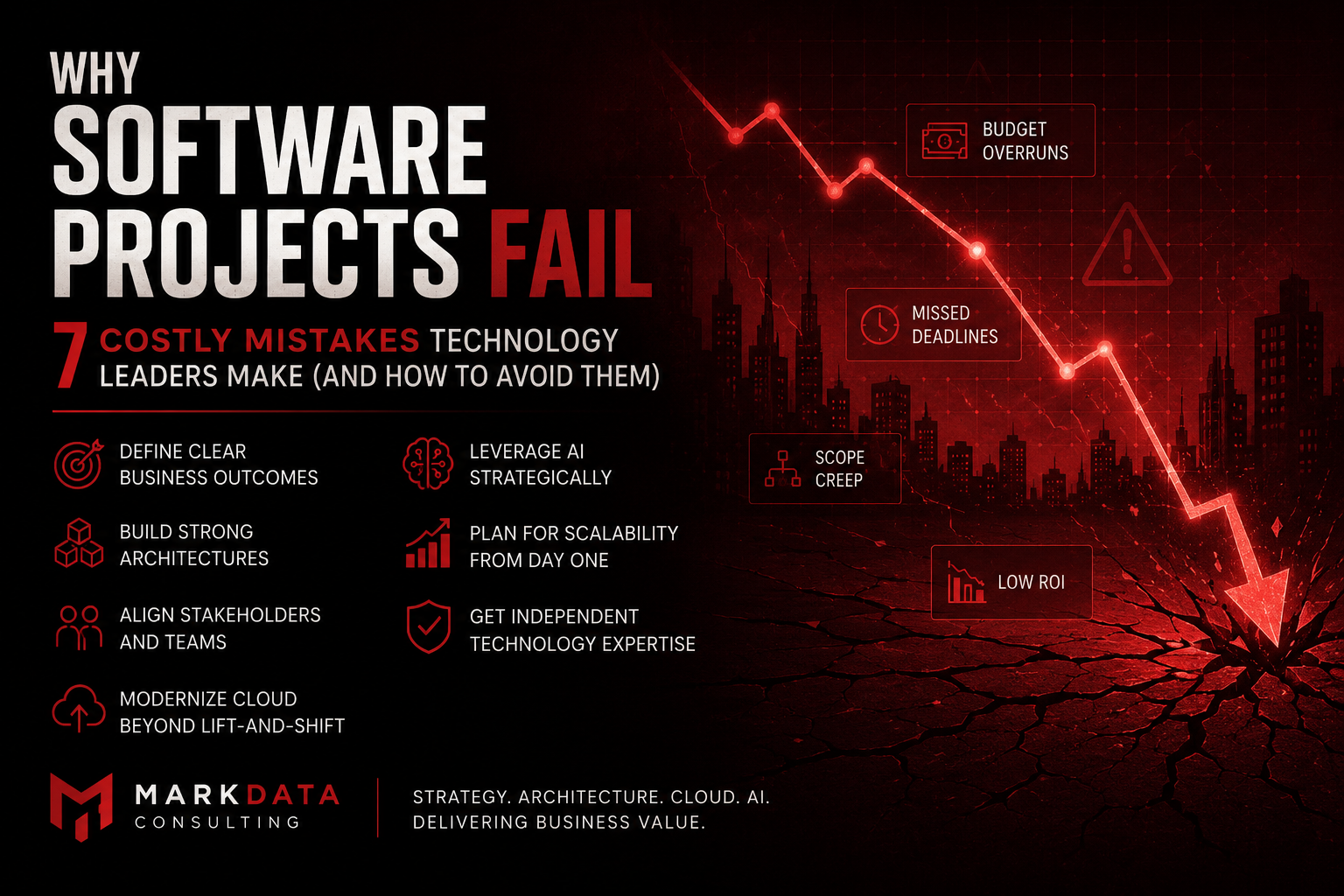
Why Software Projects Fail: 7 Costly Mistakes Technology Leaders Make (And How to Avoid Them)
Introduction
Every year, companies invest millions of dollars in software initiatives expecting increased efficiency, better customer experiences, and accelerated growth. Yet a surprising number of projects miss deadlines, exceed budgets, or fail to deliver the expected business value.
The problem is rarely technology itself.
Most project failures stem from strategic, architectural, and execution decisions made long before the first line of code is written.
At MarkData Consulting, we have worked with technology organizations ranging from startups to enterprise software vendors. Across industries, we consistently see the same patterns emerge.
Here are seven costly mistakes technology leaders make—and practical ways to avoid them.
1. Building Without a Clear Business Outcome
Many organizations start projects with technical goals rather than business goals.
Common examples include:
- Migrating to the cloud because competitors are doing it
- Adopting AI without a defined use case
- Rebuilding platforms without measurable success criteria
Successful projects begin with questions such as:
- What business problem are we solving?
- How will success be measured?
- What ROI do we expect?
Technology should always support business objectives—not the other way around.
2. Underestimating Architectural Decisions
Short-term architectural choices often create long-term technical debt.
Examples include:
- Poor service boundaries
- Monolithic systems that should be modular
- Inefficient data models
- Lack of scalability planning
The cost of fixing architectural mistakes later can be 10x higher than getting them right from the beginning.
A well-designed architecture provides flexibility, scalability, and faster future delivery.
3. Ignoring Product and Stakeholder Alignment
One of the biggest reasons projects fail is misalignment between:
- Product teams
- Engineering teams
- Business stakeholders
- Customers
When stakeholders operate with different expectations, projects experience scope creep, delays, and frustration.
Regular roadmap reviews and structured decision-making frameworks significantly improve outcomes.
4. Treating Cloud Migration as a Lift-and-Shift Exercise
Moving applications to AWS, Azure, or Google Cloud does not automatically reduce costs or improve performance.
Organizations often migrate existing inefficiencies into the cloud and then face:
- Higher infrastructure costs
- Operational complexity
- Performance bottlenecks
Successful cloud transformations focus on modernization, optimization, and operational excellence—not just migration.
5. Failing to Leverage AI Strategically
Artificial Intelligence has become a boardroom priority.
However, many companies struggle to answer fundamental questions:
- Which processes should be automated?
- Where can AI create measurable value?
- How should AI integrate with existing workflows?
The most successful AI initiatives target specific business outcomes such as:
- Developer productivity
- Customer support automation
- Data analysis
- Workflow optimization
AI works best when aligned with business strategy and operational processes.
6. Neglecting Scalability During Growth
What works for 100 users may not work for 100,000 users.
As organizations grow, they often encounter:
- Performance issues
- Reliability concerns
- Data bottlenecks
- Operational challenges
Scalability should be considered from day one through:
- Capacity planning
- Distributed architectures
- Monitoring strategies
- Performance testing
Growth should be anticipated, not reacted to.
7. Missing Independent Technology Leadership
Many organizations lack experienced technical advisors who can evaluate decisions objectively.
Without independent expertise, companies risk:
- Vendor lock-in
- Technology misalignment
- Unnecessary complexity
- Increased delivery risk
Strategic technology consulting helps leadership teams make informed decisions that support long-term business goals.
How Leading Organizations Reduce Project Risk
The highest-performing technology organizations consistently focus on:
✓ Business-first decision making
✓ Strong architectural foundations
✓ Clear stakeholder alignment
✓ Cloud optimization strategies
✓ Practical AI adoption
✓ Scalability planning
✓ Independent technical expertise
These principles help reduce risk while accelerating innovation and delivery.
How MarkData Consulting Can Help
At MarkData Consulting, we help software companies and technology-driven organizations:
- Define technology strategy
- Design scalable architectures
- Accelerate cloud transformations
- Implement AI solutions effectively
- Optimize engineering organizations
- Modernize enterprise platforms
- Deliver complex software initiatives successfully
Whether you’re launching a new product, modernizing an existing platform, or exploring AI opportunities, our team can help you reduce risk and maximize business value.
Ready to discuss your technology challenges?
Contact MarkData Consulting to schedule a strategy discussion and discover how we can help your organization build, scale, and innovate with confidence.